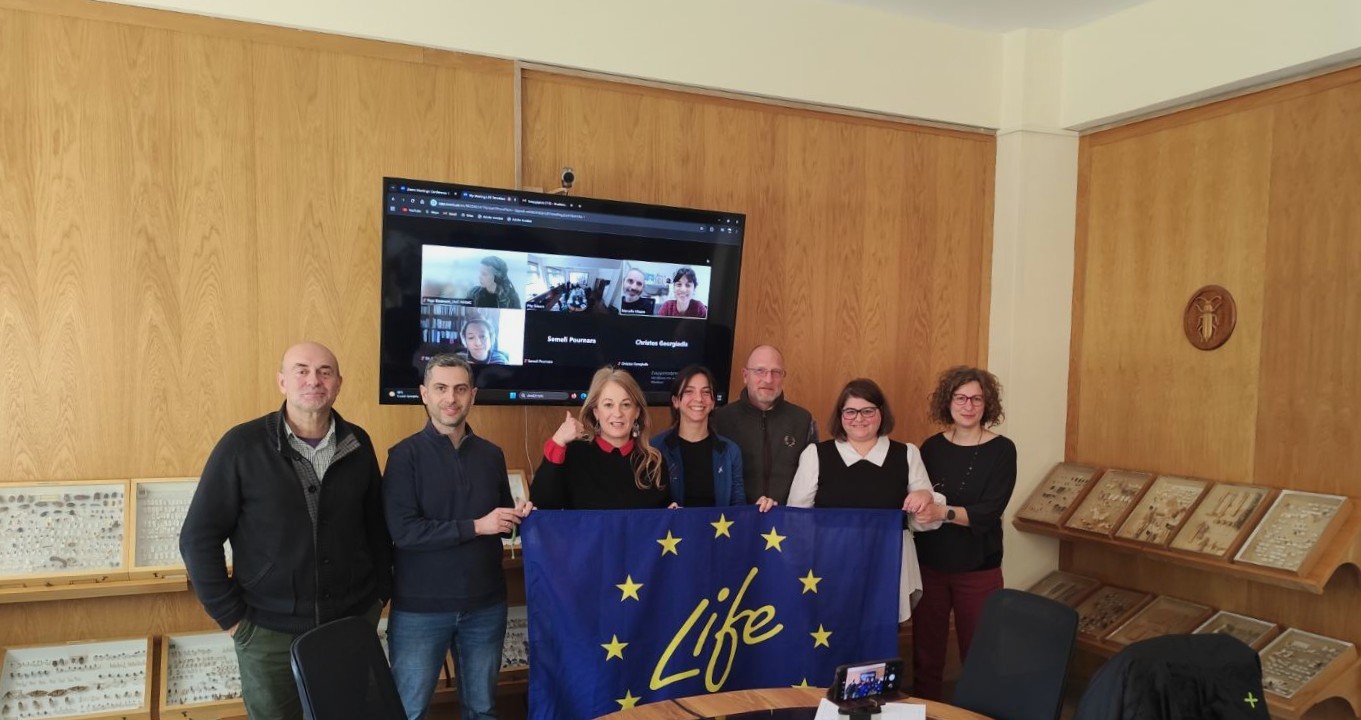

The 11th of March 2026 marked a new operational milestone for LIFE terrAmare, with a coordination meeting dedicated to the Greek partnership: an opportunity for strategic discussion that enabled the consortium to delve into the details of the activities planned for the coming years, strengthening the dialogue within the consortium between scientific research, land management and technological innovation.
The meeting, held in Athens at the headquarters of the Institute of Mediterranean Forest Ecosystems (IMFE) at ELGO-DIMITRA, was attended by the partners Foundation for Research and Technology – Hellas (FORTH), Hellenic Society for the Protection of Nature (HSPN) and the University of Crete (UoC), together with the D.R.E.AM. Italia coordinator. The meeting focused on planning the activities scheduled for the two-year period 2026–2027, most of which are dedicated to interventions on dune and coastal habitats within the Greek sites of the Natura 2000 network, with a focus on defining field interventions, mapping and engaging local stakeholders.
Among the key themes that emerged, considerable attention was paid to the development of innovative and participatory tools for environmental monitoring. In this context, FORTH’s contribution marks an important step towards integrating citizen science into project activities: the development of a mobile app is now at an advanced stage, which will enable citizens and stakeholders to actively contribute to data collection and the identification of plant species using machine learning models, thereby reinforcing an inclusive approach to the conservation of important habitats.
At the same time, preparatory work for the field campaigns at the sites of Corfu (Limnothalassa Korission, Kerkyra – GR2230002) and Gavdos (Nisoi Gavdos Kai Gavdopoula – GR4340013), which will include detailed mapping, geomorphological analyses and the planning of restoration measures, including dune stabilisation, the control of invasive plant species, and the creation of areas dedicated to the propagation and planting of native species, through seed collection and propagation activities with the support of local nurseries.
Another key focus of the discussion was the involvement of local stakeholders, which lies at the heart of Work Package 2. Over the coming months, the Greek partners will organise meetings across the region to map and build networks of stakeholders and strengthen dialogue with local communities and operators, laying the foundations for the development of Ecological Beach Communities as tools for collaboration and shared management.
The meeting concluded with the identification of the next operational steps, confirming the strengthening of coordination between partners and the launch of a new, increasingly concrete and integrated phase of the project’s activities.